- Company Career Pages
- Employee Referrals
- Hired
- Work at a Startup
- AngelList
- Glassdoor
- whitetruffle
- Hacker News: Who Is Hiring
- Wrapping Up
Editor’s note: This post was written in 2015 and updated in 2019. Several of the job platforms it describes shut down in 2023 and 2024, and each section now carries a note on its current status. I am keeping the post as a record of how Silicon Valley job platforms rose and fell over a decade. If you are job hunting today, please go by the channels marked as still operating.

This series started with my experience job hunting in the US as a software engineer, which covered the talent shortage in Silicon Valley and my own job search. The previous post, “Waiting for Opportunities: How Do I Get Recruiters to Notice Me, and Does LinkedIn Matter?”, explained how a good online presence can make jobs come to you. This post covers the next step: once you are ready to search in earnest, which websites and platforms does everyone in the US use, and how do they compare?
First, if you are about to job hunt, your resume, cover letter, and LinkedIn profile should be completely free of spelling and grammar mistakes. Your resume will need small adjustments for different types of companies. Your cover letter, especially, should show how much you want to join that particular company. LinkedIn can be the deciding nudge when a recruiter is on the fence about contacting you. If these three essentials are not polished before you start, you can spend hours applying and still get dismissed at a glance for looking unprofessional. (Editor’s note: by 2026, cover letters are rarely read for software engineering roles in US tech. The weight is on the resume itself and on your experience and projects. Customize a cover letter only if you have time left over.)
If your school has a writing center, use it. There are also plenty of resume services online, so search around for one that fits you.
Now to the main question. Your resume and cover letter are ready, and you are about to start. Which platforms should you use? Here are my conclusions from experience. They may not be 100 percent correct, but they should not be far from reality.
Company Career Pages
Recruiter response speed: 2 stars (out of 5) Number of openings: 1 star (for a single site or platform)
The most ordinary method, and it still works. If you want to work at Google, Facebook, Apple, LinkedIn, Amazon, or Twitter (now X), find an opening on the company’s career page and apply online. Many companies now screen resumes with software first, and only the resumes that pass reach a human recruiter, so tailor your resume to the job description before you submit it.
Employee Referrals
Recruiter response speed: 5 stars Number of openings: 1 star
This is basically the same as the method above, except that when you spot an opening on a company site, you do not apply right away. You ask a friend who works there to refer you internally. The advantage of a referral is that a recruiter is guaranteed to see your resume, which makes a response much more likely. Silicon Valley tech companies also prefer interviewing candidates referred by their own employees, so if a friend can refer you, definitely ask.
Updated in 2019: The Most Effective Way to Get Interviews: Internal Referrals, Where to Find Them, and the Taiwanese Mutual-Help Referral Network
Recruiter response speed: 4 stars Number of openings: 4 stars
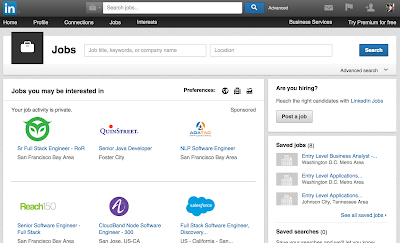
Did you know LinkedIn also lists a huge number of jobs? Recruiters at mid-size and large companies all search LinkedIn for future employees, and they post their openings there too. The nice thing is that for some jobs you can apply quickly: one click on Apply Now, attach your resume and cover letter, hit Submit, and you are done. It is fast and easy, and if you later come across the same job again, LinkedIn shows that you already applied, so you never apply twice by accident.
Hired
(This section is a status note added when the post was republished.)
Hired was a popular job site in the US back then, and it worked differently from traditional job boards. You did not search for jobs. Once you passed their screening and filled out your profile, including your target salary, the platform published your profile and let companies bid on you. Interested companies sent you the role, the salary, and the job description directly, and if you liked what you saw, you could schedule an interview right away. Companies on Hired were aggressive, and some candidates finished all three rounds of interviews and landed a job within a week.
The platform no longer exists. In June 2024, Hired was incorporated into LHH, part of the Adecco Group, and the marketplace where companies bid on candidates came to an end. Its peers disappeared around the same time. Vettery was folded into the Hired brand back in 2021. TripleByte, which matched candidates to many companies through a single screening test instead of a resume, shut down in 2023, and its assessment technology was acquired by the interviewing company Karat. Letting companies bid on you was a fashionable way to job hunt after 2015. Now it survives only in posts like this one.
Work at a Startup

Work at a Startup is a new kind of job-matching site created by Y Combinator (YC). YC is the well-known startup accelerator behind companies like Airbnb, Dropbox, Stripe, Coinbase, Reddit, Docker, and Twitch. On Work at a Startup you build a profile, and the YC startups participating in the program can all see it. If one of them is interested, they contact you directly. You can also browse all their openings and apply yourself.
At the time of writing, YC’s portfolio companies were worth about 155 billion dollars in total, with 102 companies valued at over 150 million dollars each (source: YC’s website, at the time of writing; as of 2026, YC reports a combined portfolio valuation of over 600 billion dollars). Building one profile and being considered by many well-known Silicon Valley companies is a very efficient way to job hunt. (Editor’s note: Work at a Startup is still operating today.)
AngelList
Recruiter response speed: 4 stars Number of openings: 4 stars

Most jobs on AngelList were startup jobs, from companies with single-digit headcounts to startups that had just grown to one or two thousand people. Because most startups were desperate for people, if you applied to a posting (applying felt a bit like LinkedIn, only simpler and faster), you would usually hear back within three to seven days. Early on, applying was so quick and easy that I sent out a pile of applications without looking closely. After many phone screens, I realized a lot of those companies were not right for me, and I had wasted both sides’ time. So my advice: still check each company carefully before applying, and only apply to places you would genuinely want to join.
(Editor’s note: AngelList’s job search product was spun off into a standalone platform called Wellfound at the end of 2022. For startup jobs today, use Wellfound.)
Glassdoor
Recruiter response speed: 3.5 stars Number of openings: 3 stars

You probably know Glassdoor as the place to check a company’s reviews and salary ranges, but fewer people know it also lists many job openings. The advantage of using Glassdoor is that while you apply, you can read the company’s reviews at the same time. You might discover a reason you would not want to join after all, and learning that early saves you valuable time.
(Editor’s note: Glassdoor was merged into Indeed in July 2026. The site, reviews, salary data, and job listings continue to operate as before.)
whitetruffle
Recruiter response speed: 4 stars Number of openings: 4 stars

I basically thought of it as a site similar to AngelList, though some companies chose to post on whitetruffle instead. (Editor’s note: whitetruffle is still operating, but it is a small, niche platform now.)
Hacker News: Who Is Hiring
Recruiter response speed: 4 stars Number of openings: 2.5 stars
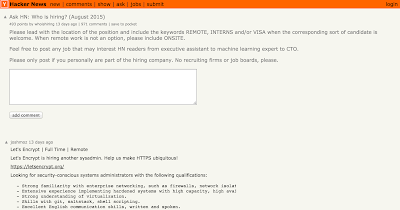
Software engineers all know Hacker News. On the first weekday of every month there is a “Who is hiring” thread, and every company with openings posts there. The people posting are usually recruiters or closely connected to the hiring team, so replies to applications tend to be fast. You can find each month’s thread through the official whoishiring account. (Editor’s note: the monthly thread is still running, though posting volume is now noticeably below its 2021 peak.)
Wrapping Up
My later experience is that most of these sites have their own advantages, but many openings are cross-posted on several of them. Picking two or three sites and focusing your applications there is enough. Checking every site every day is exhausting, and not necessarily more effective. I hope you find the sites you like for applying (or for letting companies bid on you, even though that model has now passed into history), and land your dream job in the US soon.
Next post: Software Engineer Interview Prep: What to Practice, and How to Balance It With the Job Hunt
This post was originally published on my former blog, 「半路出家軟體工程師在矽谷」, on August 15, 2015 (updated in 2019). The blog is now offline, and the text is preserved via the Wayback Machine. It has been lightly edited for this site, with editor’s notes added to reflect the situation in 2026.
